Active Recall: What It Is and How to Study With It
Active recall is a study method where you pull information out of your memory instead of reading it again. You close your notes, answer a question or write down what you know, and only then check. Researchers call it retrieval practice, and the boost it gives your memory the testing effect. Recalling feels harder than rereading, which is exactly why it works.
This guide covers what active recall is, the research behind it, six ways to do it, a worked example, examples by subject, how to combine it with spaced repetition, and the mistakes that quietly turn it back into rereading.
What is active recall?
Active recall means answering from memory before you look. Passive review means looking first. The difference is not the material or the tool, it's whether the answer is hidden while you try.
| Passive review (looking first) | Active recall (answering first) |
|---|---|
| Rereading your notes or the textbook | Covering your notes and answering the questions in the margin |
| Highlighting the important parts | Writing everything you remember on a blank page, then checking |
| Reading a flashcard's front, then its back | Saying the answer out loud before you flip the card |
| Reading through a worked example | Solving the same problem with the solution covered |
| Rewatching the lecture | Explaining the lecture's main idea from memory |
A quick test for any study session: if you could have done it with your eyes on the answer, it was passive.
Why active recall works: the testing effect
The clearest demonstration is a 2006 experiment by Henry Roediger and Jeffrey Karpicke. Students learned a short prose passage, about the sun or about sea otters, in four study periods. One group read the passage all four times. Another read it three times and then wrote down everything they could remember. A third group read it once and recalled it three times. Then each student took a final test, either five minutes later or a week later.
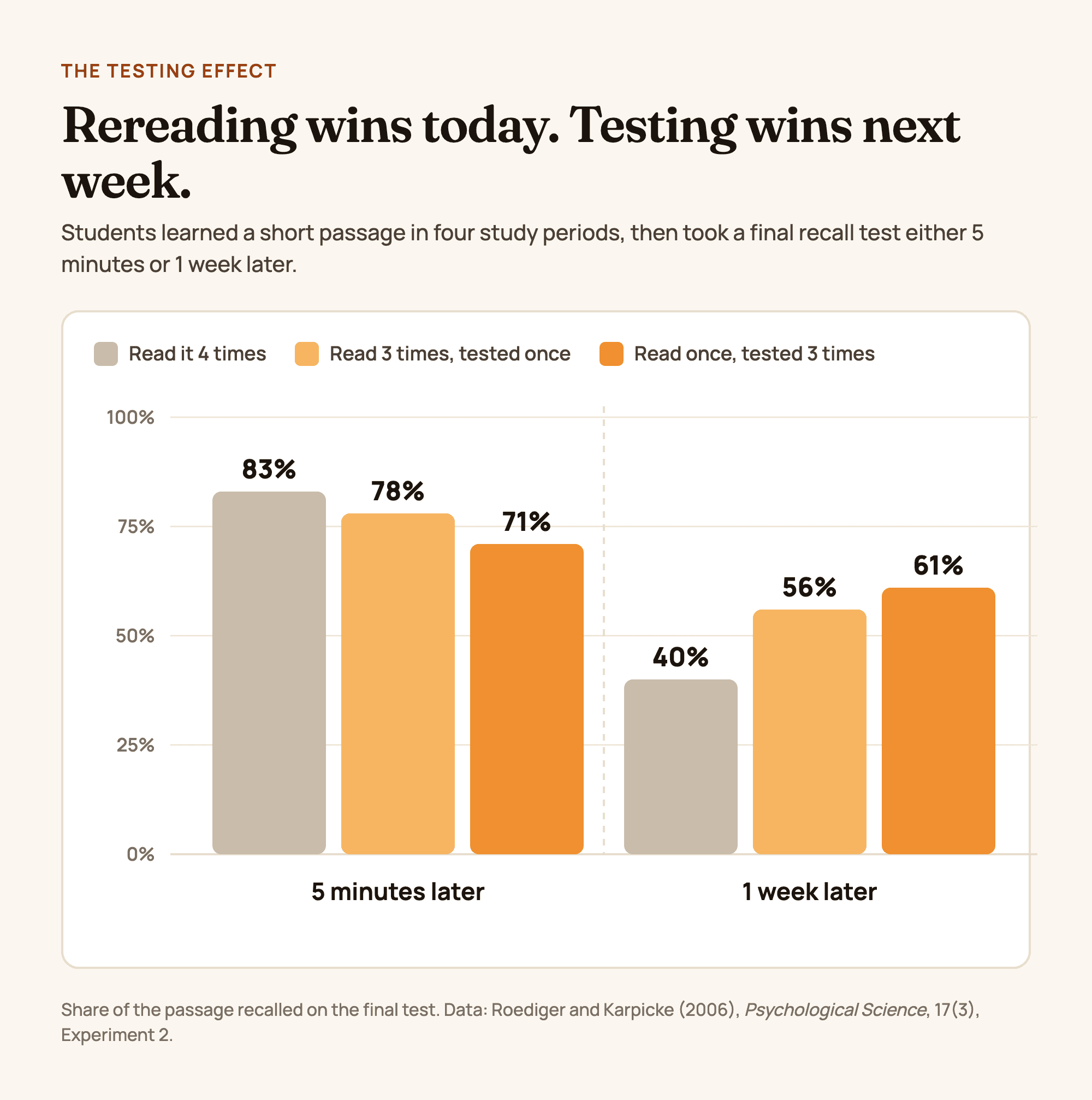
Figure 1. Recall of a prose passage 5 minutes and 1 week after studying it four ways, from Roediger and Karpicke (2006), Experiment 2. Original chart of the published results, not a product screenshot.
Five minutes later, rereading won: 83% recalled against 71% for the students who mostly tested themselves. A week later the result flipped. The rereaders were down to 40%, while the students who had tested themselves three times still recalled 61%. Rereading helps you pass a test right now. Recall helps you remember next week.
The same study shows why students still reread. The four-time readers predicted they would remember the passage best a week later; they remembered it worst. Rereading feels smooth because the words are familiar, and that familiarity is easy to mistake for knowing. The psychologist Robert Bjork calls the effort of recall a "desirable difficulty": it feels worse while you do it, and it pays off later.
The finding has held up far beyond one lab:
- A review of ten common study techniques rated practice testing as one of only two with high usefulness, because it helped across a wide range of learners, materials and test formats (Dunlosky and colleagues, 2013). The other was spacing your study out over time.
- A meta-analysis of testing versus restudying found that recall-style practice, where you produce the answer, gave larger benefits than recognition-style practice such as picking from options (Rowland, 2014).
- Yet when 177 college students listed how they study, 84% said they reread, and only 11% said they tested themselves. Only 2 of the 177 named self-testing as their main strategy (Karpicke, Butler and Roediger, 2009).
How to use the active recall study method: 6 ways
1. Turn your notes into questions
After class, write one question beside each chunk of notes: "What are the four stages of mitosis?", "Why does the market price fall when supply rises?". To review, cover the notes and answer the questions. This is the cue column of Cornell notes, and it works on any page with a margin.
2. Blurt a topic onto a blank page
Close everything and write all you remember about one topic: facts, diagrams, formulas, links between them. Then check against your notes in a second colour and re-study only what you missed. The full method, with a worked example: the blurting method.
3. Use flashcards, the right way
Flashcards are active recall only if you answer before you flip. Say or write the answer, then check. Two habits make them much stronger:
- Keep cards in the deck after you get them right. In a study on learning vocabulary, dropping a word from practice once it had been recalled correctly sharply cut how much students remembered a week later (Karpicke and Roediger, 2008).
- Ask how and why, not only what. "Define osmosis" checks a definition. "Why does a cucumber slice go limp in salty water?" checks that you understand it.
4. Explain it from memory
Pick one concept and explain it out loud or on paper, as if to someone new to the subject, without your notes. Where you stall or reach for jargon, you've found a gap. This is the core of the Feynman technique, and it suits concepts better than flashcards do.
5. Do practice problems before you look at the solution
In math, physics, chemistry and economics, recall means solving, not reading. Cover the worked example and redo it. Attempt past exam questions closed-book, then mark them. If you get stuck, look at one step only, cover it again, and keep going.
6. Quiz yourself before you study, too
Trying to answer questions on a topic before you read about it, even if you get them wrong, can improve how much you learn from the reading afterwards (Richland, Kornell and Kao, 2009). Before a chapter, write the three questions you think it will answer and have a go at them.
Active recall example: one page of biology
Say your notes cover the stages of mitosis. Here's one round.
1. Write the questions, notes closed.
- What are the stages of mitosis, in order?
- What happens to the chromosomes in metaphase?
- What pulls the sister chromatids apart in anaphase?
- How is cytokinesis different in plant and animal cells?
2. Answer from memory.
- Prophase, metaphase, anaphase, telophase. 2. They line up in the middle. 3. The spindle? 4. Plants make a wall, animals pinch.
3. Check against your notes and mark the gaps. Question 1 is right, though many courses add prometaphase. Question 2 needs "at the metaphase plate, attached to spindle fibres at their centromeres". Question 3 was a guess: spindle fibres attached at the kinetochores shorten and pull the chromatids to opposite poles. Question 4 is right but thin: plant cells build a cell plate; animal cells form a cleavage furrow.
4. Re-study only the marked parts, then repeat. Ask the same four questions again tomorrow, then in a few days. The questions stay the same; the marks should shrink each round.
Active recall examples by subject
| Subject | What to recall | How to do it |
|---|---|---|
| Math | Methods and when to use them | Redo worked examples with the solution covered; say which method a problem needs before you solve it |
| Physics | Laws, diagrams, the reasoning | Draw the force diagram from memory; explain why a result follows, not only the formula |
| Chemistry | Reactions, mechanisms, trends | Write the equation or mechanism on a blank page, then balance and check it |
| Biology | Processes and structures | Blurt a process in order; label a blank diagram |
| History | Causes, sequences, significance | Draw the timeline from memory; answer "why did this happen when it did?" |
| Languages | Vocabulary, conjugations, grammar | Translate from your language into the target language, not only the other way |
| Literature | Themes, quotes, arguments | Write a thesis and three supporting quotes from memory, then check the text |
| Computer science | Algorithms, complexity, syntax | Write the algorithm on paper and trace it by hand on a small input |
Active recall and spaced repetition
Active recall is how you review. Spaced repetition is when. One round of recall is good; the same questions answered again tomorrow, then a few days later, then a week later, are far better, because each attempt comes when the memory has started to fade and takes a little more effort. Flashcard apps such as Anki combine the two automatically. On paper you can do the same with a simple schedule: spaced repetition, with a study schedule shows how.
For how active recall fits with the other techniques worth your time, see how to study effectively.
Common active recall mistakes
- Peeking. One glance at the answer turns recall into recognition. Commit to an answer, even a wrong one, before you check.
- Only recognising. Multiple choice, and reading a flashcard's back while nodding, test recognition. Produce the answer yourself as often as you can.
- Skipping the check. Recall without checking can lock in mistakes. Mark every answer right, partly right or wrong.
- Retiring a question after one right answer. Answering once does not mean you'll still know it next week. Keep it in rotation, just less often.
- Asking only "what" questions. Definitions are easy to recall and easy to forget. Mix in why, how and what-if questions.
- Spending the session writing questions. Making questions helps, but the gain comes from answering them. Write quickly, answer often.
- Doing it once, the night before. A single round helps a little. Several rounds over days help a lot.
Make it yours in Wren
Wren is the notes app we make, for iPad, iPhone and the web. Three ways to turn your notes into active recall that answers back.
Watch a page write itself, then keep it. A blurting page in real ink, stroke by stroke. Save it to your Wren notes and blurt your own topic underneath.
TRY IT ON A REAL PAGE
Watch Wren's AI write the page. Then make it yours.
Wren's AI writes a study page in real ink, stroke by stroke. Save it to your Wren notes, then keep writing on it, on the web or on iPad.
Wren’s AI writes the page here.
Make it yours.
This is real ink, not a picture. Save it to your Wren notes and it becomes your page.
- Write your own notes next to it
- Erase or move any line, box or diagram
- Ask Wren's AI to explain or extend it
Free to start. One account for Wren on the web and on iPad. More pages to try
Answer from memory, then ask what you missed. In the Wren iPad app, write your answers with Apple Pencil, notes closed. Then write "What did I miss about mitosis?" and pause. Wren's AI reads the page and answers in ink on the same page: the missing stage, the spindle in a labelled diagram, or a corrected step. Keep it or discard it, and check it against your notes. On a laptop, open the Wren web app in any browser and type or sketch on a whiteboard page; there the ink is not drawn in a handwriting style matched to yours.
PAUSE YOUR PEN
Write. Pause. Wren's AI answers on your page.
No chat window to copy from. Wren reads what is already on the page and adds the next part in ink, right where you are working.
- WriteOn iPad, write with Apple Pencil. On the web, type or sketch on a whiteboard page.
- PauseStop for a moment. Wren reads what is on the page.
- AI answers in inkWren's AI adds the graph, formula, diagram or next step on the same page, in ink you can edit.
Rather ask a question? On iPad, open Study Buddy: it reads the page and can add its answer in ink. On the web, Ask Wren answers questions about the open page.
Turn a note into a quiz sheet. In the Wren iPad app, Wren's Flashcards agent turns your notes into a question-and-answer sheet you can quiz yourself with: the questions come first and the answers sit at the end, so you can cover them. It does not schedule reviews for you; plan those with a calendar or a spaced repetition app.
Or ask your AI to add practice questions. Connect ChatGPT or Claude to Wren once, then paste this:
ASK CHATGPT OR CLAUDE
Ask your AI. It writes in Wren.
Connect Wren to ChatGPT or Claude once. Then ask in the chat, and Wren writes the page into your notebook in ink, ready to edit on the web or on iPad.
Paste this into ChatGPT or Claude
Add a practice-question page on the stages of mitosis to my Biology note in Wren.
- Connect WrenAdd the Wren plugin in ChatGPT, or add Wren as a custom connector in Claude. Sign in to Wren with your email or Google.
- Paste the promptYour AI finds the note by its title or subject, or starts a new one, and Wren writes the page.
- Keep writingOpen the note in Wren. The page is real ink: write next to it, erase or move any part.
Your AI sees note titles, subjects and page lists, not the writing on your pages. It adds pages and can redo pages Wren wrote; it never changes what you wrote. The ChatGPT plugin is available in the US and Canada.
Your AI writes the page into that note as handwritten-style ink. It can list your notes by title, create notes, add pages, plan notebooks, draw figures and redo pages Wren wrote. It cannot read or change your own writing. Setup for Claude and other MCP apps is in the Wren connector docs; for ChatGPT, see how to install the Wren plugin.
Keep reading
- How to study effectively: active recall alongside the other techniques with strong evidence, plus a study plan for exams.
- Spaced repetition, with a study schedule: when to repeat each round of recall so it sticks.
- The blurting method, step by step: active recall for a whole topic at once.
- The Feynman technique: recall plus explanation, for concepts you need to understand.
- Note-taking methods compared: nine ways to take notes, and which ones make recall easy.
Sources
Checked November 15, 2026.
- Roediger, H. L., and Karpicke, J. D. (2006). Test-enhanced learning: taking memory tests improves long-term retention. Psychological Science, 17(3), 249 to 255. Figure 1 redraws Experiment 2.
- Dunlosky, J., Rawson, K. A., Marsh, E. J., Nathan, M. J., and Willingham, D. T. (2013). Improving students' learning with effective learning techniques. Psychological Science in the Public Interest, 14(1), 4 to 58.
- Rowland, C. A. (2014). The effect of testing versus restudy on retention: a meta-analytic review of the testing effect. Psychological Bulletin, 140(6), 1432 to 1463.
- Karpicke, J. D., Butler, A. C., and Roediger, H. L. (2009). Metacognitive strategies in student learning: do students practise retrieval when they study on their own? Memory, 17(4), 471 to 479.
- Karpicke, J. D., and Roediger, H. L. (2008). The critical importance of retrieval for learning. Science, 319(5865), 966 to 968.
- Richland, L. E., Kornell, N., and Kao, L. S. (2009). The pretesting effect: do unsuccessful retrieval attempts enhance learning? Journal of Experimental Psychology: Applied, 15(3), 243 to 257.
Frequently asked questions
What is active recall?
Active recall is a study method where you retrieve information from memory instead of reading it again. You close your notes, answer a question or write down what you know, and only then check. Psychologists call it retrieval practice, and the memory boost it gives the testing effect.
Is active recall the same as retrieval practice?
Yes. Retrieval practice is the term researchers use; active recall is the name most students know it by. Both mean pulling an answer out of memory without looking at it first. Practice testing, self-quizzing and free recall are all forms of it.
Does active recall actually work?
Yes, it is one of the best-supported study techniques. In a well-known experiment, students who tested themselves on a passage remembered 61% of it a week later, against 40% for students who reread it four times (Roediger and Karpicke, 2006). A major review of ten study techniques rated practice testing as one of only two with high usefulness (Dunlosky and colleagues, 2013).
How do I start using active recall?
Take the page of notes you would normally reread. Turn each section into a question, cover the notes, and answer each question out loud or on paper before you check. Mark what you missed, re-study only that, and ask yourself the same questions again in a few days.
What is the difference between active recall and spaced repetition?
Active recall is how you review: by pulling the answer from memory. Spaced repetition is when you review: in sessions spread out over days and weeks, with longer gaps as you learn the material. They work best together, which is what flashcard apps such as Anki do.
Are flashcards active recall?
Only if you answer before you flip. Reading the front and then the back, nodding along, is recognition, not recall. Say or write the answer first, keep cards in the deck after you get them right once, and write cards that ask why or how, not only what.
Can AI help with active recall?
Yes, as a checker and question writer, not as the one doing the recall. Answer from memory first, then ask an AI what you missed. In Wren you write your answer on the page, ask what is missing and pause, and the AI answers in ink beside it. Check what it adds against your notes or textbook.