Blurting Method: How to Study by Blurting, Step by Step
The blurting method is a study technique where you study one topic, close your notes, and write down everything you remember on a blank page. Then you check your page against your notes, add what you missed in a second colour, re-study only those gaps, and blurt the same topic again a few days later. It turns a page of notes into a test you can take anywhere, and every blurt shows you exactly what you don't know yet.
Blurting is popular with GCSE and A-level students in the UK, but it works for any exam that asks you to recall and connect ideas. Below: the steps, a full worked example, how to blurt in each subject, a spaced schedule, how it compares with other methods, and the mistakes that make it a waste of time.
What is the blurting method?
Blurting is a simple form of active recall, also called retrieval practice: instead of putting information into your head by rereading, you practice pulling it out. Researchers have found that recalling material strengthens memory far more than reading it again, even though rereading feels easier (Roediger and Karpicke, 2006). The blank page is what makes blurting work. There are no prompts to lean on, so the page shows what you really know, in your own order and your own words.
The check is the other half. A blurt with no check only proves what you remember. Checking it against your notes shows what you forgot and what you got wrong, and that list becomes your next study session.
How to do the blurting method, step by step
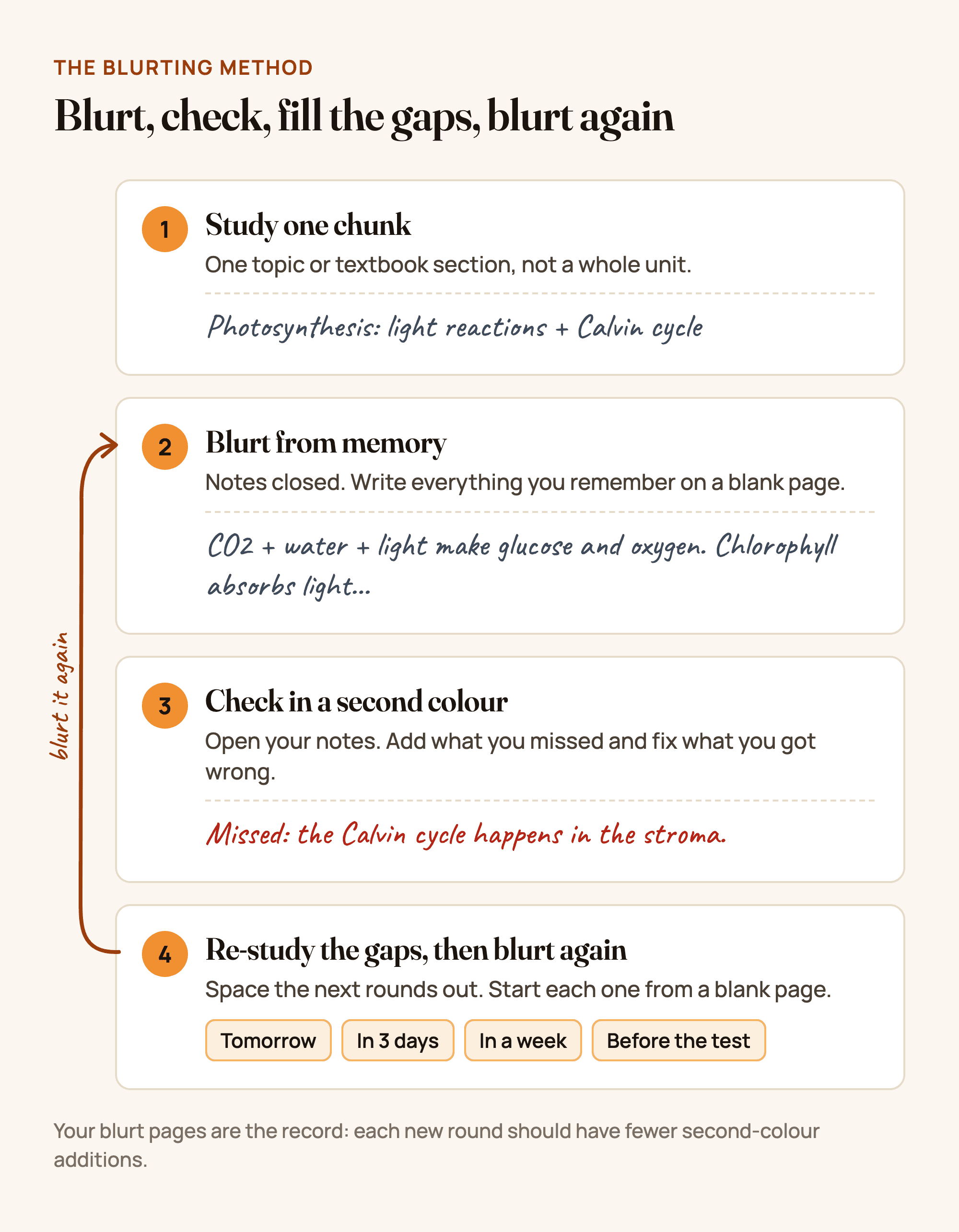
Figure 1. The blurting method as a loop, worked on photosynthesis, with a spaced schedule for the next rounds. An original diagram, not a product screenshot.
Step 1: Pick one chunk and study it
Choose one topic or one textbook section, not a whole unit: "photosynthesis", not "plant biology". Study it the normal way, from your notes, the textbook or the lecture slides, until you think you know it.
Step 2: Close everything and blurt from memory
Put your notes away. On a blank page, write everything you can remember about the topic: key terms, definitions, equations, steps, examples, and the links between them. Don't worry about order or neatness; speed matters more than tidiness. Draw the diagram or the cycle if the topic has one. Some students set a short timer to keep the pen moving. Stop when you run dry, not when you feel ready.
Step 3: Check it against your notes in a second colour
Now open your notes and go through them point by point. In a different colour:
- add everything you missed;
- fix anything you got wrong;
- mark anything you wrote but weren't sure of.
The second colour is the most useful thing on the page. It is a map of your gaps.
Step 4: Re-study only the gaps
Don't reread the whole chapter. Go back to the source for the second-colour points only, and make sure you understand why each one is true. If a gap is a concept rather than a fact, the Feynman technique is the better tool: explain it in plain words until it holds up.
Step 5: Blurt again later, from a blank page
Blurt the same topic again on a fresh page, without looking at the last one. Do it a day later, then a few days later, then a week later (see the schedule below). Each round should need less of the second colour. When a blurt comes out complete and correct, the topic is ready for practice questions.
Blurting method example: photosynthesis
Here is one round on a topic from introductory biology.
The blurt (notes closed):
Photosynthesis: plants use light to make glucose. CO2 + water → glucose + oxygen. Happens in chloroplasts. Chlorophyll absorbs light (green). Two stages: light reactions and the Calvin cycle. Calvin cycle makes glucose. Light reactions make energy.
The check (second colour, notes open):
- Balanced equation missing: 6CO2 + 6H2O → C6H12O6 + 6O2, using light energy.
- Wrong: chlorophyll reflects green light. It absorbs mostly red and blue light, which is why leaves look green.
- Missed: the light-dependent reactions happen in the thylakoid membranes. They split water, release oxygen, and make ATP and NADPH.
- Missed: the Calvin cycle happens in the stroma. It uses that ATP and NADPH to fix CO2 into sugar, with the enzyme RuBisCO.
- Missed, and a common exam trap: the oxygen released comes from the water, not from the CO2.
The gaps to re-study: where each stage happens, what the light reactions hand to the Calvin cycle, and where the oxygen comes from. That is three focused questions instead of a whole chapter to reread.
The next blurt should now include both locations, the ATP and NADPH link, and the source of the oxygen. If it does, stretch the gap before the next round.
Blurting by subject
The steps stay the same. What you blurt, and what you check for, changes with the subject.
| Subject | What to blurt | What to check for |
|---|---|---|
| Biology | The process as a flowchart or cycle, with every label | Missing stages, wrong locations, steps in the wrong order |
| Chemistry | Reactions, balanced equations, conditions, mechanisms | Balancing, conditions such as temperature or catalyst, state symbols |
| Math | Formulas, when each applies, then one fresh problem solved from memory | Forgotten conditions, sign errors, a step you skipped |
| Physics | Laws, equations with units, a free-body diagram for a standard case | Units, directions of forces, the assumptions behind an equation |
| History | A timeline of events, causes and consequences, key people | Dates, the causal links between events, missing causes |
| English literature | Themes, key quotes for each character, the context | Quotes word for word, which character said what |
| Languages | Vocabulary for a topic, a conjugation table, grammar rules with examples | Spelling, accents, irregular forms, exceptions to the rule |
| Economics | The diagram from memory, such as a supply and demand shift, and what it shows | Axis labels, which curve shifts and in which direction |
For math, check your blurt against the formula sheet and error log from how to take math notes.
How often to blurt: a spaced schedule
One blurt helps; repeated blurts spread over days help much more. This is the spacing effect: practice spread out over time is remembered far longer than the same practice crammed into one session (Cepeda and colleagues, 2006). A simple starting schedule for each topic:
- Same day: right after you first study it.
- Next day: from a blank page, without looking at the first blurt.
- A few days later.
- A week later.
- Before the test: a final blurt, then practice questions.
Let the second colour set the pace. If a round needs almost no additions, wait longer before the next one. If it needs a lot, bring the next round closer and re-study first. Keep each round on its own dated page, so you can see the gaps shrink.
Blurting vs other study methods
| Method | What it trains | Best for | Weak spot |
|---|---|---|---|
| Rereading | Recognition | A first pass over new material | Feels productive but tests nothing |
| Flashcards | Recall of single facts | Vocabulary, definitions, dates, formulas | Doesn't test how the facts connect |
| Blurting | Recall of a whole topic, with its links | Processes, causes, themes, any topic with a structure | Needs an honest check against your notes |
| Feynman technique | Understanding | Concepts where the question is "why" | Slower; one concept at a time |
| Practice questions | Applying what you know | The last stage before a test | Gaps can hide behind lucky guesses |
They work best together: blurt to find the gaps, use flashcards for the facts you keep missing, the Feynman technique for the concepts you can't explain, and practice questions to finish.
Blurting is easier from notes built for it. Cornell notes put a question beside every chunk, so each page is a ready-made self-test. For the other layouts and which one suits each subject, see note-taking methods compared.
Common blurting mistakes
- Blurting too much at once. A whole unit produces a thin, vague page. One chunk per blurt.
- Peeking. One glance at your notes turns recall into copying. Close everything first.
- Checking only for what's missing. Wrong points are worse than missing ones, because you will repeat them in the test. Fix them in the second colour.
- Noting the gaps but not re-studying them. The check is only useful if the next session goes straight to the second-colour points.
- Writing lists with no links. Blurt the arrows and the "because" too, not only the terms.
- Blurting once. A single blurt the night before is better than nothing, but spaced rounds are what make it stick.
- Making it pretty. A blurt is a test, not a set of notes. Messy is fine; slow is not.
Make it yours in Wren
Blurting needs a blank page and a second colour. In Wren on iPad, the page can also answer back after you blurt.
- Blurt by hand on a blank page. Open a new page in Wren on iPad and write everything you remember with Apple Pencil, notes closed. On a laptop, open the Wren web app in any browser and type or sketch on a whiteboard page instead.
- Pause and ask what you missed. Under your blurt, write "What did I miss about photosynthesis?" and pause. Wren's AI answers in ink on the same page: the missing points, the balanced equation or a labelled diagram of the chloroplast. Check it against your notes, which stay the reference.
- Keep the gaps, then blurt again. Each answer arrives as a draft you keep or discard, so keep only what you actually missed. Next round, start a new page, blurt from memory again, and compare.
TRY IT ON A REAL PAGE
Watch Wren's AI write the page. Then make it yours.
Wren’s AI writes this page in real ink, stroke by stroke. Save it to your Wren notes and keep writing on it, on the web or on iPad.
Wren’s AI writes the page here.
Make it yours.
This is real ink, not a picture. Save it to your Wren notes and it becomes your page.
- Write your own notes next to it
- Erase or move any line, box or diagram
- Ask Wren's AI to explain or extend it
Free to start. One account for Wren on the web and on iPad. More pages to try
PAUSE YOUR PEN
Write. Pause. Wren's AI answers on your page.
No chat window to copy from. Wren reads what is already on the page and adds the next part in ink, right where you are working.
- WriteOn iPad, write with Apple Pencil. On the web, type or sketch on a whiteboard page.
- PauseStop for a moment. Wren reads what is on the page.
- AI answers in inkWren's AI adds the graph, formula, diagram or next step on the same page, in ink you can edit.
Rather ask a question? On iPad, open Study Buddy: it reads the page and can add its answer in ink. On the web, Ask Wren answers questions about the open page.
ASK CHATGPT OR CLAUDE
Set up a blurting checklist from ChatGPT or Claude
Connect Wren to ChatGPT or Claude once. Then ask in the chat, and Wren writes the page into your notebook in ink, ready to edit on the web or on iPad.
Paste this into ChatGPT or Claude
Add a photosynthesis checklist page to my Biology note in Wren with the key points I should be able to blurt from memory.
- Connect WrenAdd the Wren plugin in ChatGPT, or add Wren as a custom connector in Claude. Sign in to Wren with your email or Google.
- Paste the promptYour AI finds the note by its title or subject, or starts a new one, and Wren writes the page.
- Keep writingOpen the note in Wren. The page is real ink: write next to it, erase or move any part.
Your AI sees note titles, subjects and page lists, not the writing on your pages. It adds pages and can redo pages Wren wrote; it never changes what you wrote. The ChatGPT plugin is available in the US and Canada.
Keep reading
- Note-taking methods: 9 systems and when to use each: where blurting fits, and which note-taking method suits each subject.
- The Feynman technique, step by step: for the concepts your blurts keep getting wrong.
- How to study effectively: blurting inside a 7-day exam plan, with five other evidence-based techniques.
- How to review and organize notes with Wren: build a repeatable review path from one page.
- How Wren adds AI ink to handwritten notes: the write, pause, review loop in detail.
Frequently asked questions
What is the blurting method?
Blurting is a study technique where you study one topic, close your notes, and write down everything you can remember on a blank page. You then check what you wrote against your notes, add what you missed in a second colour, re-study those gaps, and repeat the blurt later. It is a simple form of active recall.
Is the blurting method effective?
Blurting combines two of the best-supported study techniques: retrieval practice (recalling from memory) and spaced practice (repeating it over days). A large 2013 review of study techniques rated both as highly useful. Blurting works best when you check every blurt against your notes and re-study the gaps, not when you only write and stop.
How often should you blurt a topic?
A common starting schedule is the same day you study it, the next day, a few days later, a week later, and again before the test. Stretch the gap when a blurt comes out nearly complete, and shorten it when you add a lot in the second colour.
Is blurting better than flashcards?
They do different jobs. Flashcards test one fact at a time and suit vocabulary, definitions and dates. Blurting tests a whole topic at once, so it shows whether you can connect the pieces as well as recall them. Many students use flashcards for the facts their blurts keep missing.
Can you use the blurting method for math?
Yes. Blurt the formulas, when each one applies and the steps of a method, then solve a fresh problem from memory. Check both against your notes or the worked solutions. In math the gap is often a condition you forgot, such as when a rule does not apply.
Should you blurt on paper or on an iPad?
Either works; writing by hand is quick for arrows, diagrams and equations. On an iPad, give each round its own page so you can compare rounds and see the gaps shrink. In Wren you can also pause after a blurt and ask the AI what is missing, and its answer appears in ink on the same page.