The Feynman Technique: 4 Steps, With a Worked Example
The Feynman technique is a way to learn a concept by explaining it in plain words, finding where your explanation breaks down, and fixing those gaps. It has four steps: pick a concept, explain it as if to a 12-year-old, find the gaps and go back to the source, then simplify and explain it again. If you can explain an idea simply and completely, you understand it. If you can't, you now know exactly what to study.
You will also see it called the Feynman method or the Feynman learning technique. Below are the four steps, a full worked example from physics, examples for other subjects, the research behind it, the mistakes that make it fail, and a checklist to copy onto your page.
What is the Feynman technique?
The technique is named after Richard Feynman, the physicist who shared the 1965 Nobel Prize in Physics and became famous for explaining hard ideas in everyday language. Feynman never published a four-step recipe. The steps are a modern summary of how he worked: in James Gleick's biography Genius, Feynman starts a notebook titled "Notebook of things I don't know about" and works through each topic until he can rebuild it himself.
The idea underneath is simple. Reading a page makes a topic feel familiar, and familiar feels like understood. Explaining it from scratch tests that feeling. Psychologists call the gap between the two the "illusion of explanatory depth": people rate their understanding of everyday things, such as how a zipper works, far higher before they try to explain them step by step than after (Rozenblit and Keil, 2002). The Feynman technique turns that moment of "wait, I can't actually explain this" into your study plan.
The 4 steps of the Feynman technique
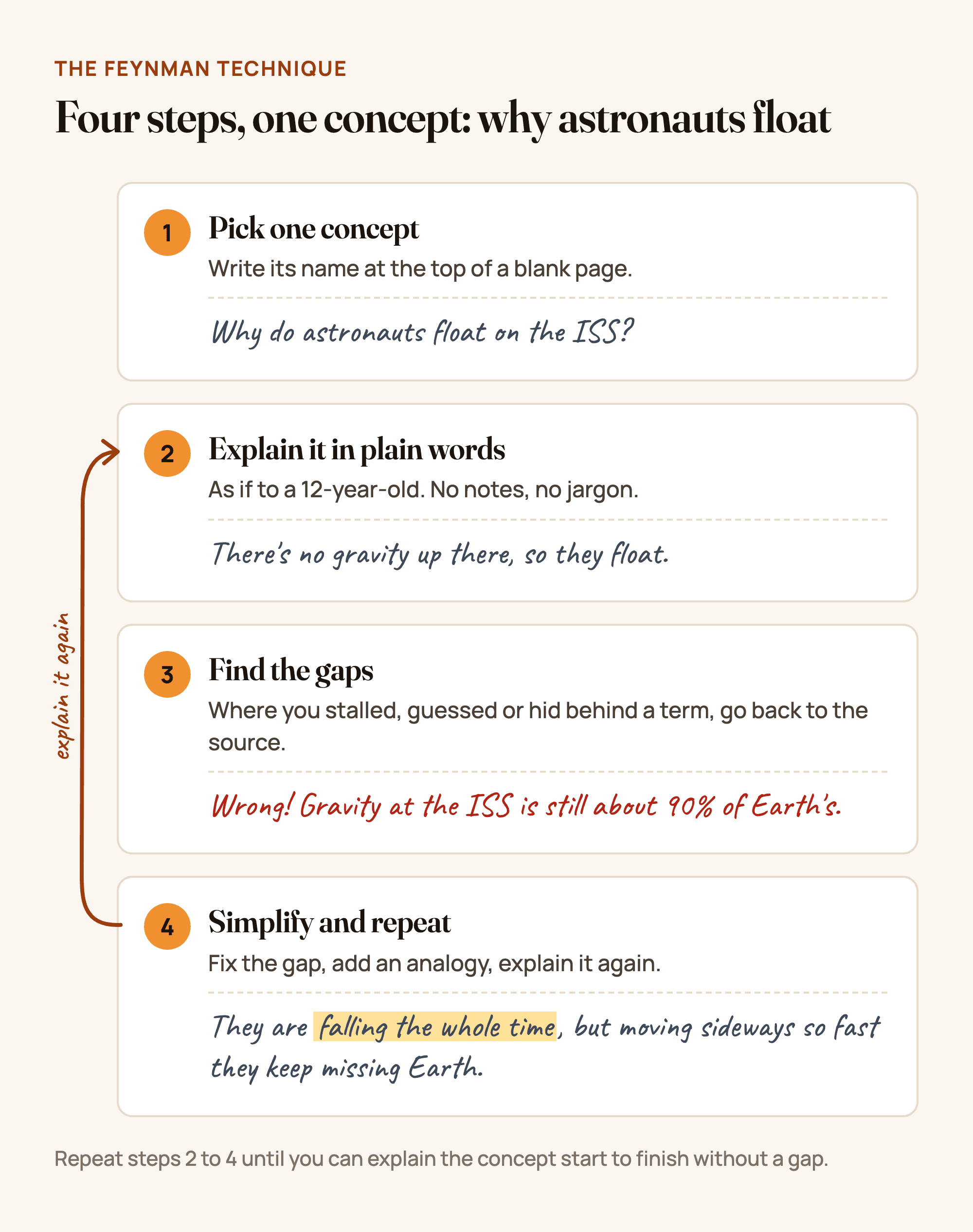
Figure 1. The Feynman technique as four steps, with the astronaut example worked through each one. An original diagram, not a product screenshot.
Step 1: Pick one concept and write it at the top of a blank page
Choose one idea, not a chapter. "Thermodynamics" is too big; "why entropy increases in an isolated system" is the right size. Writing it as a question helps, because a question has an answer you can check: "Why do astronauts float on the ISS?" is easier to test than "orbits".
Step 2: Explain it in plain words, as if to a 12-year-old
Close your notes and write the explanation from memory, in short sentences and everyday words. Use one concrete example. If you need a technical term, define it in the same sentence. Writing beats thinking it through in your head, because a written explanation has gaps you can see. Saying it out loud works too.
Step 3: Find the gaps and go back to the source
Read your explanation back and mark every place where:
- you stalled or had to guess;
- you used a term you could not define without your notes;
- you wrote "basically", "somehow" or "and then it just works";
- you skipped a step between cause and effect;
- your example did not quite fit.
Each mark is a gap. Now open your textbook or lecture notes, but only for those marked points. This is what makes the technique efficient: you re-study the exact parts you don't understand instead of rereading the whole chapter.
Step 4: Simplify, add an analogy, and explain it again
Rewrite the explanation from scratch rather than patching the first draft, so the fixed parts connect to everything else. Add an analogy if you can find one. Then repeat steps 2 to 4 until you can explain the concept start to finish without a gap. The final test is outside the page: answer a practice question, or explain it to a real person and survive their "but why?".
Feynman technique example: why do astronauts float?
Here is the full loop on one concept from introductory physics.
Step 1, the concept. Why do astronauts float on the International Space Station?
Step 2, the first explanation.
In space there's no gravity, so nothing pulls the astronauts down and they float around.
Step 3, the gaps. Read back critically, the explanation has three problems:
- "No gravity" is wrong. The ISS orbits roughly 400 km (about 250 miles) above Earth. Gravity weakens with distance, but at that height it is still about 90% as strong as on the ground. Something else must explain the floating.
- If gravity pulls on them, why don't they fall? The first draft has no answer. That is the real gap.
- "Float" hides the idea. What would it take for a person to feel weightless while gravity still acts on them?
Back to the source, the textbook chapter on orbits gives the missing piece: an orbit is free fall. The station and everyone in it are falling toward Earth all the time, but they are also moving sideways at about 28,000 km/h (17,500 mph). As they fall, Earth's curved surface drops away beneath them just as fast, so they keep missing it.
Step 4, the simpler explanation.
Gravity up at the space station is almost as strong as on the ground. The astronauts float because they and the station are falling together, all the time. They never hit the ground because they are also moving sideways incredibly fast: as they fall, Earth curves away underneath them, so they keep missing it. When you and the room around you fall together, nothing presses you against the floor, so you feel weightless.
Analogy: imagine firing a cannonball sideways from a very tall mountain. Faster and faster shots land farther and farther away. Fire it fast enough and the ground curves away as quickly as the ball drops, so it goes all the way around. That is an orbit, and it is the picture Isaac Newton himself used.
The transfer test. Can you now explain why the Moon doesn't fall into Earth? It is the same idea: the Moon is falling toward Earth all the time and moving sideways fast enough to keep missing. If that answer came easily, the concept is yours.
Feynman technique examples by subject
The same four steps work in any subject. What changes is where the gaps tend to hide.
| Subject | Concept | Where the gap usually hides | Plain-words test question |
|---|---|---|---|
| Math | The derivative | "It's the slope of the tangent line", without saying what that slope measures | How fast is y changing at this exact x, and how do two nearby points get you there? |
| Chemistry | Le Chatelier's principle | "The equilibrium shifts to oppose the change" | What happens to the molecules, reaction by reaction, when you add more reactant? |
| Biology | Osmosis | "Water moves down its concentration gradient" | Why does a cucumber slice go limp in salty water? |
| Economics | Opportunity cost | "The value of the next best alternative forgone" | What did you really give up by going to the movies tonight? |
| Computer science | Recursion | "A function that calls itself" | Why doesn't it run forever, and what does each call hand back? |
| History | Causes of World War I | A memorized list of causes with no links between them | How did one assassination in Sarajevo turn into a war between empires? |
If you can answer the test question in plain words, you have closed the gap. If you reach for the textbook phrase in the middle column, you haven't yet.
In math, run the test on a worked example: say why each step follows from the one before. How to take math notes shows a two-column layout, the step and the why, that sets this up on the page.
Why the Feynman technique works
No study has tested "the Feynman technique" as a branded four-step package, so be wary of anyone who promises a number. Its ingredients, though, are some of the best-studied ideas in learning science:
- Self-explanation. Students who explain worked examples to themselves, step by step, learn more and solve new problems better than students who just read them (Chi and colleagues, 1989 and 1994). A large review of study techniques by Dunlosky and colleagues (2013) rated self-explanation as moderately useful across many subjects (how to study effectively sorts all ten techniques it rated).
- Retrieval practice. Step 2 happens from memory, which makes it a form of retrieval practice (active recall), one of the two techniques that same review rated most useful. Recalling information strengthens memory more than rereading it (Roediger and Karpicke, 2006).
- Preparing to teach. Students who expected to teach a passage recalled more of it, and organized it better, than students who expected a test (Nestojko and colleagues, 2014). Explaining for a 12-year-old puts you in that teaching frame.
- Breaking the illusion of understanding. Explaining exposes what rereading hides (Rozenblit and Keil, 2002), and step 3 makes you act on what you find.
Common Feynman technique mistakes
- Picking a topic that's too big. A whole unit produces a vague summary with gaps everywhere. One concept, one page.
- Explaining with your notes open. That turns step 2 into copying, and copying hides every gap. Close the book first.
- Hiding behind jargon. "It's because of entropy" is a label, not an explanation. If a 12-year-old would ask what the word means, define it.
- Explaining only in your head. Mental explanations skip steps without noticing. Write it down or say it out loud.
- Patching instead of rewriting. Adding the missing fact to the first draft leaves it disconnected. Rewrite the whole explanation in step 4.
- Stopping when it sounds right. Fluent is not the same as correct. Finish with a practice question or a new example, like the Moon test above.
- Using it for facts that need memorizing. Dates, vocabulary and formulas are better served by flashcards, the cue column of Cornell notes or the blurting method. The Feynman technique is for concepts, where the question is "why".
Make it yours in Wren
The technique works on paper. On iPad, Wren lets the page answer back, so you can find gaps without leaving the explanation you wrote.
- Write your explanation on the page. Open a note in Wren on iPad, write the concept at the top and your plain-words explanation under it with Apple Pencil. On a laptop, open the Wren web app in any browser and type or sketch on a whiteboard page instead.
- Pause and ask for the gap. Under your explanation, write a question such as "What's missing from my explanation?" or "Draw the ISS orbit with the gravity arrow", then pause. Wren's AI answers in ink on the same page: the missing step, a formula or a labelled diagram.
- Keep what helps, then explain it again. Each answer arrives as a draft you keep or discard. Check it against your textbook, then rewrite your explanation from scratch below it and pause again.
TRY IT ON A REAL PAGE
Watch Wren's AI write the page. Then make it yours.
Wren’s AI writes this page in real ink, stroke by stroke. Save it to your Wren notes and keep writing on it, on the web or on iPad.
Wren’s AI writes the page here.
Make it yours.
This is real ink, not a picture. Save it to your Wren notes and it becomes your page.
- Write your own notes next to it
- Erase or move any line, box or diagram
- Ask Wren's AI to explain or extend it
Free to start. One account for Wren on the web and on iPad. More pages to try
PAUSE YOUR PEN
Write. Pause. Wren's AI answers on your page.
No chat window to copy from. Wren reads what is already on the page and adds the next part in ink, right where you are working.
- WriteOn iPad, write with Apple Pencil. On the web, type or sketch on a whiteboard page.
- PauseStop for a moment. Wren reads what is on the page.
- AI answers in inkWren's AI adds the graph, formula, diagram or next step on the same page, in ink you can edit.
Rather ask a question? On iPad, open Study Buddy: it reads the page and can add its answer in ink. On the web, Ask Wren answers questions about the open page.
ASK CHATGPT OR CLAUDE
Set up a Feynman page from ChatGPT or Claude
Connect Wren to ChatGPT or Claude once. Then ask in the chat, and Wren writes the page into your notebook in ink, ready to edit on the web or on iPad.
Paste this into ChatGPT or Claude
Add a Feynman-technique page on entropy to my Chemistry note in Wren.
- Connect WrenAdd the Wren plugin in ChatGPT, or add Wren as a custom connector in Claude. Sign in to Wren with your email or Google.
- Paste the promptYour AI finds the note by its title or subject, or starts a new one, and Wren writes the page.
- Keep writingOpen the note in Wren. The page is real ink: write next to it, erase or move any part.
Your AI sees note titles, subjects and page lists, not the writing on your pages. It adds pages and can redo pages Wren wrote; it never changes what you wrote. The ChatGPT plugin is available in the US and Canada.
Feynman technique checklist
Copy this onto the top of your page and tick it off each round:
- One concept, written as a question at the top of a blank page.
- Explained from memory, with notes closed.
- Plain words, with every technical term defined in the same sentence.
- At least one concrete example.
- Every gap marked: a stall, a guess, jargon, "somehow", a skipped step.
- Each gap checked against the textbook or lecture notes, and nothing else reread.
- Rewritten from scratch, with an analogy.
- Tested on a practice question or a new example.
Keep reading
- Note-taking methods: 9 systems and when to use each: where the Feynman technique fits, and which method suits each subject.
- How Wren adds AI ink to handwritten notes: the write, pause, review loop in detail.
- How to review and organize notes with Wren: turn one page into a repeatable review path.
- The blurting method, step by step: recall a whole topic from memory, then fill the gaps.
- Best note-taking app for iPad: nine apps compared if you are choosing where to study.
- Best AI for studying, and how to use it without cheating: use an AI tutor to check your explanation, not to write it.
Frequently asked questions
Does the Feynman technique actually work?
Its ingredients are well supported by research: explaining material in your own words (self-explanation), pulling it from memory (retrieval practice) and preparing to teach it all improve learning. No study tests the four-step package as one method, so judge it by a result: can you now answer a practice question you could not answer before?
Can you use the Feynman technique for math?
Yes. Explain why each step of a method works, not only what the steps are, then solve a new problem without looking at your notes. Gaps in math usually hide in the step you can do but cannot justify, such as why you divide both sides or why a limit gives the slope.
What is the difference between the Feynman technique and active recall?
Active recall means pulling information out of memory, for example with flashcards or the blurting method. The Feynman technique uses recall too, but adds two things: you explain the idea in plain words and you hunt for the places your explanation breaks. Use active recall for facts and the Feynman technique for concepts.
Did Richard Feynman invent the Feynman technique?
Not as a four-step method. It is named after the physicist Richard Feynman, who was known for explaining hard physics simply and for writing down what he did not yet understand. The four steps are a later summary of that habit, not a recipe he published.
Do I need someone to explain it to?
No. Write the explanation on a blank page as if for a 12-year-old, or say it out loud. A real listener helps because they ask why, so once your written version holds up, try it on a friend or a study group.
Can AI help with the Feynman technique?
Yes, as a checker rather than a writer. Write your own explanation first, then ask the AI what is missing or wrong. In Wren you write the explanation on the page, pause, and the AI answers in ink beside it, such as the missing step or a diagram. Check what it adds against your textbook.